How to Choose the Right Wheel Loader Bucket Size

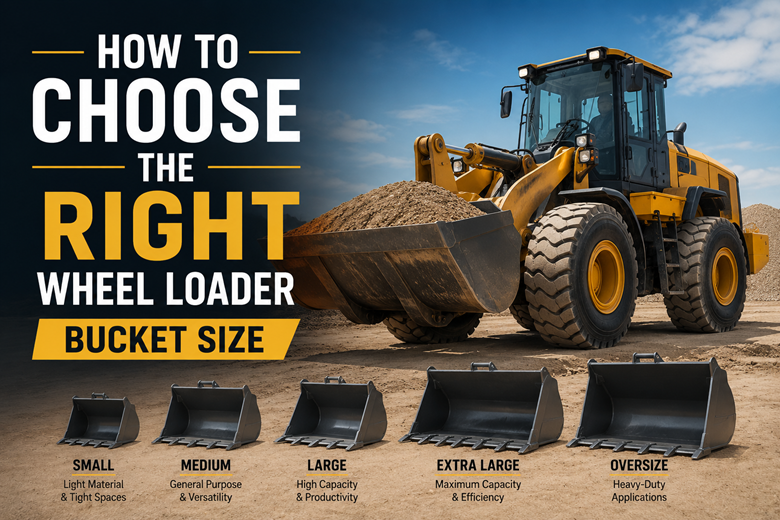
The bucket is where a wheel loader earns or wastes your money. Get the wheel loader bucket size right and every pass moves the maximum safe load fewer cycles, less fuel, more done before lunch. Get it wrong and you’ve either bought a bucket so big it overloads the machine and tips on the first heaped scoop, or one so small you’re doing twice the passes for the same pile. Here’s how to size it properly.
Why Bucket Size Is a Balancing Act
It’s tempting to think bigger is always better more in the bucket, fewer trips. But a wheel loader has a rated operating capacity (and a tipping load) for a reason. Overload the front and you lose rear-wheel traction and steering, accelerate wear on the drivetrain and tyres, and risk tipping forward when you lift and curl. Undersize it and you waste time, fuel and engine hours on extra cycles.
The right wheel loader bucket size sits in the sweet spot: big enough to move serious volume, small enough that a heaped load of your heaviest material still stays safely within the machine’s limits.
Step 1: Know Your Machine’s Limits
Start with two numbers from the loader’s spec sheet:
- Rated operating capacity / safe lift capacity — how much the machine can lift and carry safely.
- Tipping load — the point at which it starts to tip forward (rated capacity is usually a conservative fraction of this).
Every bucket you consider has to keep a full load under that limit, with margin to spare for uneven ground.
Step 2: It’s Really About Material Density
This is the step most people skip — and it’s the most important. A bucket isn’t measured in weight, it’s measured in volume (cubic metres). But the machine cares about weight. So the same bucket can be perfectly safe with one material and dangerously overloaded with another.
Rough densities to keep in mind (kg per cubic metre):
- Mulch / wood chip: ~300–400
- Dry topsoil: ~1,300–1,500
- Wet sand: ~1,800–2,000
- Gravel / road base: ~1,700–2,200
A 1 m³ bucket of mulch weighs around 350 kg. The same 1 m³ bucket full of wet road base weighs over 2 tonnes. That’s why a bucket that feels great in the garden supplies yard can put you on your nose in the gravel pile.
The rule: size your standard bucket to your heaviest regular material, not your lightest.
Step 3: Heaped vs Struck Capacity
Bucket capacity is quoted two ways. Struck is level with the bucket’s edges; heaped (SAE) is the rounded pile that sits above it. Always size using the heaped figure for the material you actually load — because that’s how your operators will fill it.
Step 4: Match the Bucket Width to the Machine
The bucket should be at least as wide as the loader’s tyres (usually slightly wider). Too narrow and the tyres run over un-dug material and leave ridges; too wide for the machine’s power and you’ll struggle to fill it cleanly. Width affects how easily the bucket penetrates and fills, not just how much it holds.
Step 5: Think About the Job, Not Just the Pile
- Loading trucks? Check your dump height and reach with the bucket you’re considering — a bigger bucket can lower effective dump clearance.
- Light, fluffy materials (mulch, grain, compost)? A light-material (high-capacity) bucket gives you more volume without adding weight risk.
- Mixed work? A 4-in-1 bucket handles loading, dozing, grabbing and levelling brilliant for property owners and landscapers who do a bit of everything.
Getting It Right — and Where Achilles Fits
This is where buying from people who actually match buckets to machines pays off. Achilles Machinery wheel loaders are offered with a range of matched bucket options general-purpose, light-material and 4-in-1 sized to each model’s rated capacity, so you’re not guessing whether a bucket will overload the front end. The team can pair the bucket to your heaviest regular material and your typical job, whether that’s loading gravel into tippers or shifting hay and feed around the property. And because Achilles backs its wheel loaders with parts and service on the ground in Australia, swapping or adding a bucket later is straightforward rather than a months-long wait on an overseas order. If you’re unsure between two sizes, it’s worth a conversation before you commit the wrong bucket is an expensive lesson.
A Simple Way to Decide
- Find your loader’s safe lift capacity (kg).
- Identify your heaviest regular material’s density (kg/m³).
- Pick the largest bucket whose heaped load of that material stays comfortably under the lift capacity.
- If you also handle light materials often, add a light-material bucket for those don’t compromise your main bucket for them.
Frequently Asked Questions
Can I just fit the biggest bucket that bolts on? No. A bucket that physically fits can still overload the machine with dense material, costing you traction, stability and drivetrain life. Always size by weight, not by what fits.
Should I size for mulch or for gravel? Always size your primary bucket for the heaviest material you handle regularly. Use a separate light-material bucket for mulch, grain or compost if those are a big part of your work.
Is a 4-in-1 bucket worth it? For mixed property, farm and landscaping work, yes it replaces several attachments and handles loading, levelling and grabbing in one. For single-material yard loading, a dedicated bucket is usually faster.
Match the Bucket to the Work
Choosing the right wheel loader bucket size comes down to three things: your machine’s safe capacity, your heaviest material, and the job in front of you. Nail those and you’ll move more, safely, on every pass. If you’d like a hand pairing a bucket to your loader and your material, the Achilles Machinery wheel loader range is on show at the Brisbane and Sydney yards six days a week bring the details of what you’re loading and we’ll help you size it right the first time.