Personalised Disability Care: What It Really Means, and How to Tell

More than one in five Australians live with disability, and “personalised” has become a popular word in the support sector. Here’s what it should look like in practice.
The 2022 Australian Bureau of Statistics’ Survey of Disability, Ageing and Carers places around 5.5 million (or 21.4%) Australians in the category of having a disability. This is a decrease from 17.7% four years ago. These numbers represent a multitude of lives – including millions of lives with their own unique set of life goals, schedules, health needs and families. Any two people will likely require different types of support.
That’s the thinking behind personalised disability care. The phrase turns up everywhere now: on provider websites, in brochures, in the conversation at a planning meeting. But a word isn’t a service. This article looks at what personalised care should mean in practice, how it fits with the NDIS, and what people with disability and their families can ask to find out whether the support on offer is really built around them.
Why one size doesn’t fit all
The Australian Institute of Health and Welfare produces a summary on people with disability that illustrates the diversity of people’s needs. Approximately 20 % of the population of all people with disability living in households required assistance in at least one of their basic activities of daily living in 2022. Of these, 30% required assistance for health care, 25% for cognitive or emotional functions and 25% for mobility. There are some individuals who just desire a helping hand at mealtimes and making it to appointments. Others are working towards catching public transport on their own. There’s a lot of people that want a blend that changes down the road.
It also identified 35 per cent of those who required help to have unmet need for formal support. This was an increase from 11 per cent who needed more and 11 per cent who got some assistance but required more. Personalised does not give the whole solution to unmet need but is certainly one part of it. Nonetheless, it is a reminder that providing support does not have to be on paper—it must fit the person’s needs.
This is one major component of that story – the NDIS. The AIHW’s quarterly reporting of more than 761,000 active NDIS participants is as at 12 Dec 2025. Now, this has been a good number of individual plans, and a good number of individual people.
What “personalised” should actually mean
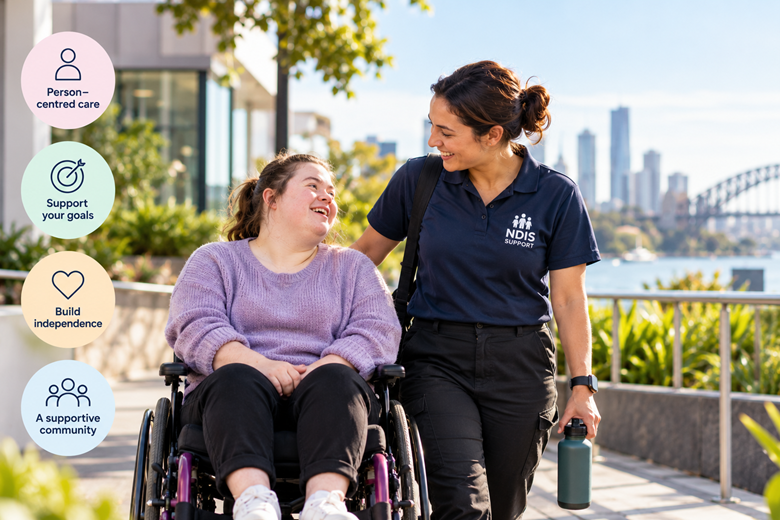
Remove the marketing and disability care personalises down to one thought: the person is the focus of the centre and support is developed around their aims and preferences as well as their life. This is person-centred support in some ways described. In action, it manifests itself in very tangible ways.
It is asking for your wish before stating what will be provided. It conducts selection of whether or not people are standing at your door; workers are not just picked randomly to turn up. It means mentoring develops you, rather than doing everything for you. It also means that, if your life changes, the plan on paper changes.
None of that is complicated. It does take time and a willingness to listen, which is why the first conversation with a provider tells you so much. If most of it is a sales pitch, that’s information too.
How it fits with an NDIS plan
People often mix up an NDIS plan and a provider’s support plan. They aren’t the same document. An NDIS plan is a package of funding for the supports a participant needs, and the NDIS says plans are built by NDIA planners with participants. According to its page on what an NDIS plan is, goals are “an important part of your plan” and give people “something to work towards where you can measure your progress”.
A provider’s care or support plan, which goes by various names, sits underneath. It describes how support will actually run: who comes, when, what they help with and how the person likes things done. The funding sets the boundaries and the support plan fills in daily life. Ideally the two point at the same goals.
How much room there is to tailor things also depends on the funding. The NDIS describes flexible supports, which can be used “in the way that suits you best”, and stated supports, which can only be used for the specific support described in the plan. A plan also covers NDIS supports only, and works “alongside the informal, community and mainstream supports you also use”. That’s worth keeping in mind, because family, friends and community connections are often a big part of a good life, and a good provider will ask about them rather than try to replace them.
Choosing a provider: registration matters
Personalisation also depends on picking the right provider, and that starts with understanding registration. The NDIS defines a provider as “a person, business or organisation that delivers NDIS supports to participants”. Providers can be sole traders, large companies, charities or not-for-profits. Some are registered with the NDIS Quality and Safeguards Commission and some aren’t.
The difference affects who a participant can use. Under NDIS guidance, people with NDIA-managed funding must use a registered provider. Participants who self-manage or use a registered plan manager can usually choose either type, although some supports can only be delivered by registered providers. Those include specialist behaviour support, plan management, specialist disability accommodation and supported independent living. Both kinds of provider have to follow the NDIS Code of Conduct. Registered providers also can’t charge more than the NDIS price limits, while unregistered providers can charge above or below them.
The NDIS also suggests meeting a new provider before starting work with them. Its guide on how to find and choose a provider says a my NDIS contact, support coordinator or recovery coach can help people find providers that fit their goals, and that reviews and recommendations from people you trust are worth a look. A first meeting is a good time to see how personal the approach really is.
Signs the support is genuinely personalised
No checklist is perfect, but these are good signs:
- The provider asks about your goals and daily life before it talks about services or prices.
- You get a say in who supports you, and workers are matched on your needs and, where possible, shared interests.
- Your support plan is written in words you understand, and it changes when you do.
- Support builds your skills at your pace instead of taking over.
- Family and carers are involved as much as you want, and no more.
- Health needs are part of the planning conversation, especially for complex support.
- The provider is upfront about what it can’t do.
Get the details in writing
A service agreement is where “personalised” becomes something you can point to. The NDIS describes it as an agreement between a participant and a provider about the NDIS supports being delivered. Its page on service agreements says one is required for specialist disability accommodation, and for most other supports it’s recommended when you start with a new provider or your needs change.
The NDIS suggests that a service agreement should include: who it is for, types of supports provided and how, costs and costs of the providers, key dates and reviews, the rights and responsibilities of you and the provider, and what to do if there is a disagreement or something goes wrong. Further, the NDIS points out, a ‘contract’ is not an agreement to work outside of the obligations of the NDIS Code of Conduct or Australian Consumer Law. Read it carefully and have it explained to you if there are any parts you don’t understand.
Where health and nursing fit in
For many people, health is a big part of daily life. The AIHW figures above show that 30 per cent of people who needed help with daily activities needed help with health care. That’s one reason some providers build their service around nursing.
In Brisbane a nurse-led NDIS service, Support for Wayfarers, says its personalised disability care starts with listening to a person’s daily life, interests and goals, interests and goals. It highlights the matching of support worker to client where possible, based on need, choice and common interests; and that it is about developing skills at the client’s own speed. The idea is consistent no matter what the model, health needs must be a part of the planning conversation, not an add-on.
Questions worth asking any provider
- How will you find out what I want from my support?
- Who will actually be supporting me, and can I meet them first?
- How do we change things if something isn’t working?
- How often will my support plan be reviewed?
- What will our service agreement cover?
- Are you a registered NDIS provider, and which of my supports can you deliver?
Clear answers are a good sign. Vague ones are worth noting.
The bottom line
Disability care is not a product and/or a brand. It is a working methodology that revolves around the person. The stakes are high as there are over five million Australians with disability and a substantial number of people on the NDIS.